Showing posts with label Kellie Ward. Show all posts

Thursday, 28 March 2013

Evaluation Q2. How does your media product represent particular social groups?

Kellie Ward

A media representation is the way in which the media regularly portray a certain type of person or group of people. This can derive from gender, social class, ethnicity, age, or social location. 

As there is just one character featured in our thriller opening, we were representing a very specific social group; It was female orientated, of a middle domestic class,

Evaluation Q.2 - How does your media product represent particular social groups?

Kellie Ward
Representation is... the way in which people/a group of people/social organization is portrayed, and the media does not always reflect true reality; it instead moulds these things in a way that is subjective to their specific media text and therefore emphasises true reality and creates a stereotypical view on the particular person/place given (e.g. Tv drama exaggerating masculinity - Life on Mars).
The main areas which are represented by the media are:
Ethnicity
                                         Social class


Ability/disability                                                         Gender

                      Age                                                                                                    Regional identity


Sexuality 


The stereotypes that we represented in our film opening are gender (female), age (young), social class (working class), and ability.

Evaluation Q.4 - Who would be the audience for your media product?


The general wide audience for thriller films is young adults-adults, most from which start from 18 years old because of age restrictions and psychological affects. Thrillers in general are not gender specific
Our target audience is of ages 16-35


The audience specific to our sub-genre (mystery thriller) 


(Created by Wordle)

Evaluation Q.6 - What have you learnt about technologies from the process of constructing this product?

To sum up the whole production and editing process, I'd say that I have been enlightened about all of the different forms of technology involved in piecing together ONE final piece. We required different digital technologies for things such as audio (Camtasia voice-overs, attachable camera microphones), video (lighting, JVC Camera, editing effects)

Q7 - Evaluation

Progression from prelim to full product.

Pre-production 

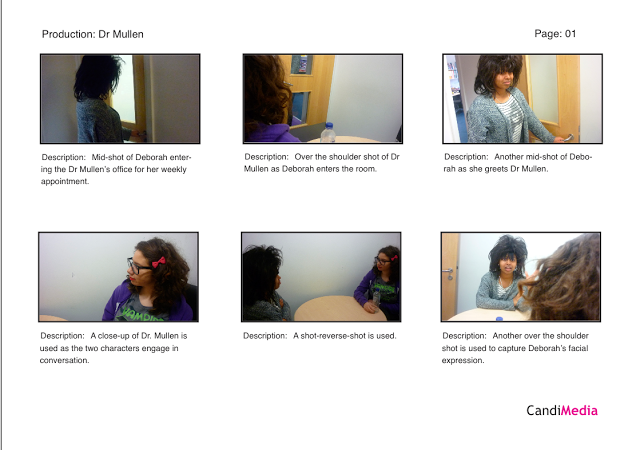
PRELIM - As we had very little experience, we didn't carry out much efficient planning for our prelim. Although we did create a digital storyboard, it only consisted of simple shot types and made no reference to the actual happenings.

We did not apply a mood board to our prelim.


THRILLER - We created a fully annotated digital storyboard for the thriller, including exact camera shots, angles, order or shots, and location to ensure that we prepared for successful filming.


During the first steps of planning the film opening, we created a mood board with suggestions of thriller sub-genres, plots, and representations


Production

Mise en scene was something that we didnt focus on with the PRELIM, the environment barely set the plot of a Doctor's office, because there were no props or costume to present this. The only thing that showed the audience the plot was character's speech. 


(Made with Final Cut Pro)

Evaluation Q5. How did you attract/address your audience?

Our target audience was of ages 15-35, and was not gender specific. We enticed this audience by using the different elements: camera, editing, sound, and mise en scene in ways that catered for them.


Wednesday, 27 March 2013

EVALUATION Q1 - How our media product connect with conventions of real media products?

Kellie Ward
There are specific conventions that film openings consist of to achieve a successful opening, these are;
Firstly music is inco-operated into majority of openings; both diegetic and non-diegetic can be used to set the overall tone of the movie and also accompany the pace of editing to ensure that a specific atmosphere is set to prepare the audience for the rest of the film.         Our thriller followed the convention of using music, however it had a twist because it wasn't music as such - it was a low bass TONE, as silence is also an effective way to create suspense and tension which thrillers are meant to do. 

Location (part of mise en scene) is another important element to give the audience opportunity to see, because it establishes the setting or at least one significant setting of the film and therefore also creates the overall plot. Environment and other parts of mise en scene can also set the time/year of the story. Location is inevitably shown through camera visuals, but may also be accompanied with special video effects, or audio effects to give a more specific, clear approach of the plot.      An establishing shot is alway used to introduce location at the beginning of the movie/scene, an establishing shot is a wide shot covering the whole room, building, or general environment. 
(Embedded via YouTube)

 
(Made with www.createagif.net)
We challenged this convention - as the Pathogen opening shot is of water pipes, it relates to the plot and story of contaminated water but doesn't reveal too much about character or regional location too early on.


A main goal is to introduce the main character or pre-plot within the opening, this literally gives the audience direct information about either the previous experiences and type of a character (e.g. gender, age, class),or previous events and situations in order to reduce confusion with future events and the rest of the film/story. Narration and on screen text can help to make situations exceedingly apparent.

Pathogen followed this type of film opening and showed a significant character 


Film titles appear in every typical film opening for practical reasons of informing people of the crew members, main roles and general co-operates involved with the movie. Of course, we included titles in Pathogen to give credit to all departments.


In film openings, there is also a typical conventional order of which the title sequences appear, this order usually consists of;


    1. Production Company opening Ident 
    2. Production Company title
    3. Distribution Company title
    4. Director/Writer
    5. Actor 1 (Lead)
    6. Actor 2 (Lead)
    7. Film Title
    8. Actor 3
    9. Actor 4
    10. Casting
    11. Costume
    12. Music/Music supervisor


    We decided to follow this specific order of titles exactly for our thriller opening as we did research and concluded that uncountable highly successful films had also used this and had a good result.


    (Created with Camtasia)

EXAMPLE OF SUCCESSFUL THRILLER WITH CONVENTIONAL TITLE ORDER
The girl with the dragon tattoo for example; used the exact recommended order of titles and proved as a real life example that this sequencing professionalises the opening.


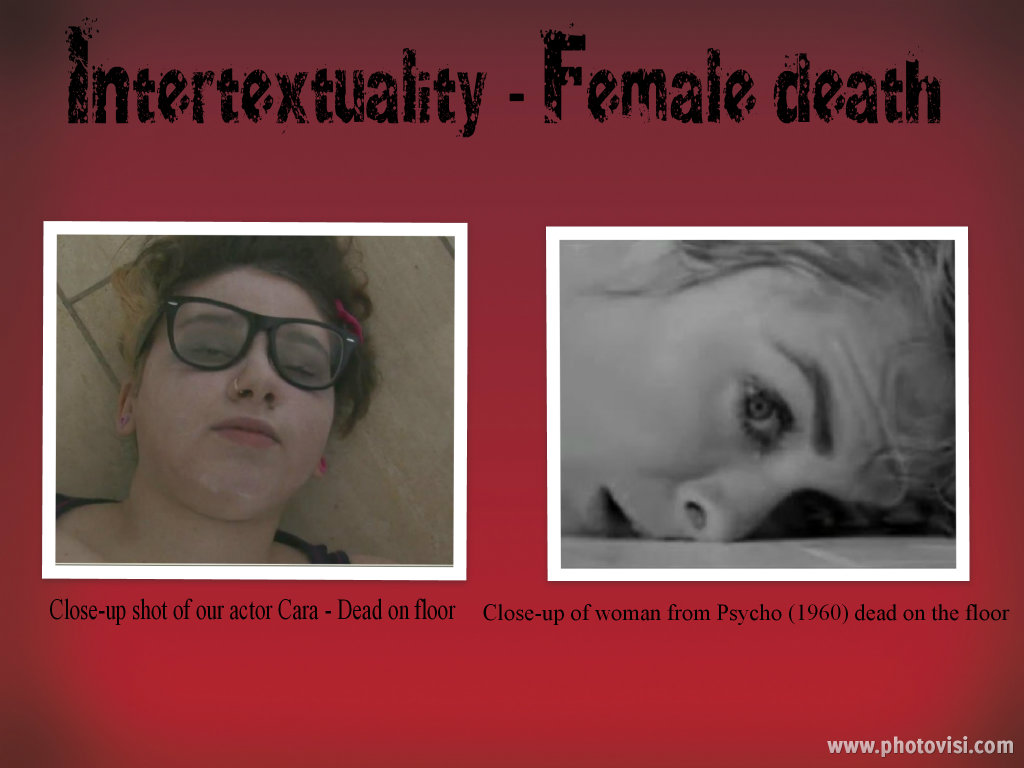
Intertextuality is something that we took into account during the very first stages of planning the thriller. We did not use many intertextual elements as we wanted to strike the audience in the most unique and individual way possible. 
However, there was one element that we extracted from many other movies (Psycho 1960 in particular) - and this was the idea of a main female character's death in the opening scene. To show a clear reference to this film we placed our actor in a similar death position and also used a close up shot = intertextuality

Monday, 25 March 2013

Evaluation Q3. What kind of media institution might distribute our media product and why?

Kellie Ward


I also created a short video sequencing some previous thriller's that Warner Brothers have invested in by producing or distributing.

Friday, 8 March 2013

Editing - The process

Editing - Final Stages of Editing

We've come to end of our editing. And as we finish which was probably the hardest part of the filming process, it really does feel like a great weight has been lifted of our shoulders. Moving on, it has felt like a great relief, saving our project. With that said, we hope you enjoy our final product!


Editing - Order of Title Sequence

This is our title sequence of the cast in this order:

- Production Company (CANDI Studios)
- Distribution Company (DAK Pictures)
- Lead Actor (Cara Mullen)
- Film Title (Pathogen)
- Actor #2 (Kellie Ward)
- Actor #3 (William Diep)
- Actor #4 (Rogazad Zephaniah) 
- Casting By (Robert Fisher)
- Costume By (Hussam Thomas)
- Music Supervisor (Keiran Williams)
- Music By (Carl Johnston)
- Edited By (Rodah Daniel)
- Production Designer (Sarah Andrews)
- Executive Producer (Deborah Daniel)
- Directed By (Anthony Fissler)

We thought it would make our film more authentic if we kept the order sequence original and followed in the footsteps of generic thriller features.


Editing - Adding Effects

Though, we created many camera effects using Final Cut Pro. Our most interesting effect was the ident transition created for our (Fictional) independent distributor, DAK Pictures. We created this one using Motion. Though, it was hard to create, at first. We soon got the hang of it and created a simple slide of film. However, for those who might criticise how simple our ident is, other groups have taken distributor idents off the web. We've decided to stay true to teacher's rules and not use any footage from the internet.

The pictures below shows our process in creating an ident: 


Motion - the programme we used to create our ident. 


We started off by typing our distribution company on a black screen.


From there, we started to experiment with transitions. 


This was the playback of our ident with the added transitions. We assure you, it's more complicated than it looks!

Editing - Rough Cut (Pathogen) Feedback

This is feedback for our rough cut opening from fellow student, Andreia. She was honest in saying it wasn't very thrilling and that we had to add more sound. Aside from those two factors, it was a decent bit of film.


Editing - Constructing A Timeline


gif maker
                                                   

After we finished filming we used Final Cut Pro to create a timeline and this was tricky because we had a time limit of about 2 minutes for the whole opening. Also because we had to make sure that the clips ran smoothly into each other and that they were at a good pace.

Wednesday, 6 March 2013

Filming - Pathogen (Rough Cut)

On our first day of editing, to initiate we simply put all of our significant clips of footage in the correct order so that we could then continue and go back to add things such as Foley sounds, soundtrack, audio/video transitions and filters, and most importantly the conventional order of TITLES. As it is a thriller opening.


Our main priority post filming was to synchronise the clips and you can see from this rough cut of Pathogen that it was far from finished and lacking emphasising conventions such as effects.

Monday, 4 March 2013

Filming - Shoot 2

This filming session took place on Monday, 18th February, at Cara's house. Being half-term, we thought it was an appropiate time to re-film the whole of Cara's scene. The problem with our orginal footage being that it was far too dark. Though, the footage appeared alright on the camera's small screen, Final Cut Pro suggets differnty of the lattter.


Not sure what Anthony's doing with the microphone, testing to see if the sound was clear.

Another picture of Anthony, this time. tweaking slight adjustments to the top light.

Kellie and Deborah are about to film Cara in bed; no pun inteded.

A distorted-looking Cara's ready to film after doing her make-up.

Overall, this filming session was slow as all of us we're rather restless working past the half-term. However, we filmed a great bit of footage and some extra scences with Cara's mother. All we need to do now is concentrate on the editing.


Filming - Shoot 1


We arrived at Cara's house which was our main location, setting out the environment and mise en scene such as an alarm clock prop was our first main priority; it was placed in a specific place and had to be left there through the entire endurance of filming for continuity purposes. (You can also see the camera tripod on the bed if you look closely, the tripod plays a huge part in filming!)

 Here Cara was preparing her deadly makeup, it is one of our most important parts of mise en scene as it visually shows the audience what is happening and that she is ill.

We thought that stairs would be a great way to show the main character's instability. We shot things such as medium close ups, tracking shots of her moving feet, low angle shots, and filming from perspective looking through Cara's eyes as she unstabely travels.


 Here is our main character Cara with her theatrical type makeup which was borrowed from a family member and came as a huge benefit to us because we have a budget of almost nothing. She is ready to lie in bed and begin the thriller.


This was a quick snapshot took whilst filming and acting was in process.

 Anthony with his camera and toplight! 


This was our first shoot on the 11th February, we filmed the beginning of our opening scene which involved Cara (the main character) waking up to discover her illness, we followed her to all different locations around her house to show perspective, this took time to get different shots. As you can see, we all took a turn at using the camera to split responsibility and get as much of a variety of footage as possible (tracking shots down the stairs, the typical medium close ups of Cara in bed).


Planning - Production Schedule

Considering the fact that we have a limited amount of filming time, we have to decided to compose a strict timetable to stick to. Below's the dates we intend to film:
  • Monday, 11th February - 9:00 - 12:15 - Cara's house - Bedroom and stairs scene
  • Thursday, 14th February - 1:15 - 2:55 - Small room next to 323 - Publib Health Official Mr Fissler's office phone call to Kellie Ward, regarding the virus. We intend to film both spectrums of the conversation.
  • Monday, 26th  February - 9:00 - 12:15  Owen's Field Park - Various death scenes involing the film's extras.
  • Monday, 18th February - 9:30 - 4:00 - Cara's house - We intend to use this Monday during the half term to re-film any footage or so.
Because we don't intend to film over any of the allocated weekends awarded, we've decided that delegating the task of equipment management won't be necessary; we'll just pick up the equipment from the college on days of filming. 

Planning - Pitch Feedback


As well as receiving feedback from the media department, we also asked our fellow students what they thought of our ideas, whether they believed we were ready to produce it, and got their opinions on the title for our film as they will be the regular civilians we expect to consume/watch it.

Sunday, 3 March 2013

Planning - Pitch


This is our pitch which we presented to members of the media department, we incorporated all of our thoughts and planning aspects into this to give not just ourselves, but others, a clear image of what we wanted our thriller to be.