Representation is a very big part of film and TV. Different groups are represented in different ways with different messages brought across. In our thriller opening there isn't really a strong example of representation, however, you could say that our thriller represents the general population of the UK as it is set in the UK and shows the vulnerability of people regular, un-vaccinated who come into contact with a water-borne disease.
We have represented the general population of the UK in a positive way; the NHS staff were helpful and efficient and there was a voice-over of a man who was very worried about his mother; this shows the caring attitudes of many people of the UK.
We did have an idea that didn;t make it into the final cut; we were going to show a conversation between government officials who were trying to cover up the disease and accept no responsibility for it. This represents the elite of the UK in a negative light and represents the distrust that many regular people of the UK have for them and is reminiscent of what we often see in real media (e.g. on the news, internet and in newspapers).
Showing posts with label Cara Mullen. Show all posts
Showing posts with label Cara Mullen. Show all posts
Thursday, 28 March 2013

Evaluation 7: Looking back at you preliminary task, what do you feel you have learnt in the progression from it to the full product?
Looking back at our preliminary task, I feel that we have learnt so much more on how to create a visually interesting media product. At the time we did our preliminary task, we had no real previous experience in creating a media product from scratch. We had done a re-make of collateral, but when it came to creating something completely new, we were completely clueless and new to the experience.
However, the preliminary task was what gave us the experience to go on to create our thriller opening. We learnt more about camera angles and techniques (e.g. Dolly-zoom), mise en scene (e.g. how to do make-up). Our location was a lot better and fitting to our storyline (unlike in our prelim where we just used the only space that was available to us). Even small things like lighting made massive improvements from our preliminary work to our final thriller opening. All these things contributed to making our thriller opening much better and more professional-looking than our preliminary work was.
Also, from our preliminary work to our final thriller opening, we got a lot better at editing (e.g. got better at match-cutting and the 180-degree rule which didn't really work out in prelim due to lack of space in our filming location), and learnt a lot more about techniques in Final Cut Pro and how to edit footage effectively and creatively (I feel our prelim was just standard editing to piece footage together without any real creativity involved). In our preliminary work, we did not add any sounds, we just used what was in the footage. However, in our final thriller opening, we learnt how to use Soundtrack Pro to add sound which makes the media product a lot more professional-looking and interesting for the audience.
At the time of our preliminary work, we also had no knowledge of title sequences, which are of course integral to any film opening. However, once we started our thriller opening, we had learnt about title sequences (e.g. the conventional order of the titles) and knew how to creatively and effectively create a title sequence to add into our footage.
I also feel that our thriller opening is a lot more creative than our preliminary work; we learnt how to create more interesting storylines using storyboards, and although I feel we had very little time to come up with an idea for our thriller opening, it was a lot more well thought-out and interesting than our preliminary storyline was.
However, the preliminary task was what gave us the experience to go on to create our thriller opening. We learnt more about camera angles and techniques (e.g. Dolly-zoom), mise en scene (e.g. how to do make-up). Our location was a lot better and fitting to our storyline (unlike in our prelim where we just used the only space that was available to us). Even small things like lighting made massive improvements from our preliminary work to our final thriller opening. All these things contributed to making our thriller opening much better and more professional-looking than our preliminary work was.
Also, from our preliminary work to our final thriller opening, we got a lot better at editing (e.g. got better at match-cutting and the 180-degree rule which didn't really work out in prelim due to lack of space in our filming location), and learnt a lot more about techniques in Final Cut Pro and how to edit footage effectively and creatively (I feel our prelim was just standard editing to piece footage together without any real creativity involved). In our preliminary work, we did not add any sounds, we just used what was in the footage. However, in our final thriller opening, we learnt how to use Soundtrack Pro to add sound which makes the media product a lot more professional-looking and interesting for the audience.
At the time of our preliminary work, we also had no knowledge of title sequences, which are of course integral to any film opening. However, once we started our thriller opening, we had learnt about title sequences (e.g. the conventional order of the titles) and knew how to creatively and effectively create a title sequence to add into our footage.
I also feel that our thriller opening is a lot more creative than our preliminary work; we learnt how to create more interesting storylines using storyboards, and although I feel we had very little time to come up with an idea for our thriller opening, it was a lot more well thought-out and interesting than our preliminary storyline was.
Evaluation 6: What have you learnt about technologies from the process of constructing this product?
In the production of our thriller opening we have used many technologies from camera equipment to computer programs.
The main computer programs we used were Final Cut Pro and Soundtrack Pro. We used the technologies in combination with each other to construct our film opening. We used Final Cut Pro to edit the footage, and Soundtrack Pro to create the music. We then used Final Cut Pro to layer the music on top of the footage.
I learned may things about both programs, here are some of the things I learnt about Final Cut Pro:
- Has high-quality rendering which makes it possible to compute realistic effects.
- Has iMovie support, the two programs are very compatible.
- You can imported layered Photoshop graphics (good for titles).
- Auto-Analysis uses people detection to determine if there is a single person or multiple people in the shot. This information is used to automatically organize shots into Smart Collections. The program then flags shots as close-up, medium, or wide, then organizes them into Smart Collections by type of shot.
The main computer programs we used were Final Cut Pro and Soundtrack Pro. We used the technologies in combination with each other to construct our film opening. We used Final Cut Pro to edit the footage, and Soundtrack Pro to create the music. We then used Final Cut Pro to layer the music on top of the footage.
I learned may things about both programs, here are some of the things I learnt about Final Cut Pro:
- Has high-quality rendering which makes it possible to compute realistic effects.
- Has iMovie support, the two programs are very compatible.
- You can imported layered Photoshop graphics (good for titles).
- Auto-Analysis uses people detection to determine if there is a single person or multiple people in the shot. This information is used to automatically organize shots into Smart Collections. The program then flags shots as close-up, medium, or wide, then organizes them into Smart Collections by type of shot.
- Analyses your media in the background to identify shaky footage. You can then apply the Stabilization effect. For additional control, you can adjust parameters manually.
- Gets rid of image distortion from quick movements. Can automatically make corrections.
- Can analyse the colour of clips on a frame-by-frame basis to produce superior results when you use the single-click Balance Color feature. The color correction is optimized for the specific frames you’ve selected.
- Can analyse and fix audio problems e.g. excessive noise.
- Can analyse and fix audio problems e.g. excessive noise.
My conclusion about the usefulness and creativity of technologies is that the technologies are useful in allowing you to be creative when creating a media product. Without these technologies, we would not have been able to create our media product, and because the technologies were so useful, we were able to show creativity and make our media product how we wanted it to be. However, sometimes the technologies are not always easy to use as they are very complex, professional programs which are quite hard for a media student to figure out how to use by themselves without never being shown and having no prior knowledge of the technologies. I found this the biggest struggle when using the programs. Also, sometimes you are limited a bit on exactly what you want to do and are not always in complete control of what your media product is going to look like, for example, you cannot just create your own imaginative transitions, you have to choose from whatever is available in Final Cut Pro, and in Soundtrack Pro, you are limited on what the music will sound like as you can only choose from the sounds available in the program.
Evaluation 5: How did you attract/address your audience?
We attracted our audience with the name of the film; Pathogen as it is short, snappy and catchy and we felt that this would make it attractive to a teenage/young-adult audience.
We also used mise en scene to attract our audience. The clothes that the main character wore were just normal, average pyjamas that a regular teenager/young-adult watching the film would likely wear. This makes the film feel 'normal' and makes the audience feel like they can identify with it and feel like it mirrors their own lives, which would make it appealing to them. The same goes for our location; it is a normal London house, not a gigantic Hollywood mansion that many of our viewers would not be able to identify with.
The main character (who was the only character in our opening) was a normal English teenager, much like our audience would be. Again, they would be able to identify with her normal life, making the storyline more shocking when she collapses due to the very abnormal water she drinks.
Our rough-cut feedback helped us to improve our film in order to give it better appeal to our intended audience. As a lot of the people who gave us feedback were representative of our target audience (English teenagers/young-adults), it was particularly helpful because they gave us feedback on what they would like to see and what would appeal to them. Their feedback was extremely valuable information and we took it all on board and added some improvements to our final cut of our thriller opening.
We have reached our audience through word of mouth because I feel that there is nothing more valuable than that; if you are recommended something by a friend, you are much more likely to try it out than if you were told to by a pushy advertisement or Facebook page. Word of mouth makes the advertising personal, and friends know what other friends like and so a recommendation makes all the difference. Also, I feel that this is the best way to specifically target our audience because if there is one thing teens and young-adults all collectively like to do, it's talk. Teens and young-adults talk all the time about everything and so films are often the topic of conversation with this age-group, and talking spreads like wild-fire.
We also used mise en scene to attract our audience. The clothes that the main character wore were just normal, average pyjamas that a regular teenager/young-adult watching the film would likely wear. This makes the film feel 'normal' and makes the audience feel like they can identify with it and feel like it mirrors their own lives, which would make it appealing to them. The same goes for our location; it is a normal London house, not a gigantic Hollywood mansion that many of our viewers would not be able to identify with.
The main character (who was the only character in our opening) was a normal English teenager, much like our audience would be. Again, they would be able to identify with her normal life, making the storyline more shocking when she collapses due to the very abnormal water she drinks.
Our rough-cut feedback helped us to improve our film in order to give it better appeal to our intended audience. As a lot of the people who gave us feedback were representative of our target audience (English teenagers/young-adults), it was particularly helpful because they gave us feedback on what they would like to see and what would appeal to them. Their feedback was extremely valuable information and we took it all on board and added some improvements to our final cut of our thriller opening.
We have reached our audience through word of mouth because I feel that there is nothing more valuable than that; if you are recommended something by a friend, you are much more likely to try it out than if you were told to by a pushy advertisement or Facebook page. Word of mouth makes the advertising personal, and friends know what other friends like and so a recommendation makes all the difference. Also, I feel that this is the best way to specifically target our audience because if there is one thing teens and young-adults all collectively like to do, it's talk. Teens and young-adults talk all the time about everything and so films are often the topic of conversation with this age-group, and talking spreads like wild-fire.
Evaluation 3: What kind of media institution might distribute your media product and why?
The production company we used in the titles for our thriller opening was Candi Studios, and Dak was our distribution company.
Both are fictional companies, but if they were real they would be quite low-budget and not big multi-million dollar companies. However, I feel that our film would be more suited to large, Hollywood production and distribution companies. This is because it feels like quite a Hollywood themed block-buster movie, like Contagion.
Both are fictional companies, but if they were real they would be quite low-budget and not big multi-million dollar companies. However, I feel that our film would be more suited to large, Hollywood production and distribution companies. This is because it feels like quite a Hollywood themed block-buster movie, like Contagion.
Monday, 25 March 2013
Evaluation 1: In what ways does your media product use, develop or challenge forms and conventions of real media products?
Our media product uses forms and conventions of real media products in terms of the conventions of film openings. Film openings usually follow set conventions. They usually have either a) a narrative opening, b) a discrete opening, or c) titles over blank screen.
Narrative openings set the scene and introduce the characters and their situations. Discrete openings are when the openings are like separate films within themselves. Titles over blank screen is when the sequence begins with a blank screen which has a title on it. Our film opening is a narrative opening in which we introduce the main character and her situation.
Our media product also challenges forms and conventions of real media products because of the way the story is so strongly embedded into the opening; more than usual film openings. A whole chunk of the storyline is in the opening, not just a tiny snippet of it like in most narrative openings.
Our media product also uses forms and conventions of real media products in terms of title sequences. Title sequences usually follow a set conventional order. This usually starts with the production company ident and the distribution company ident, and ends with the writer and director's names. Our media product follows this conventional order of titles. We begin with our production company ident, and end with or director's name. However, we also challenge the convention of film titles because instead of the usual two actors names, we only have one.
Narrative openings set the scene and introduce the characters and their situations. Discrete openings are when the openings are like separate films within themselves. Titles over blank screen is when the sequence begins with a blank screen which has a title on it. Our film opening is a narrative opening in which we introduce the main character and her situation.
Our media product also challenges forms and conventions of real media products because of the way the story is so strongly embedded into the opening; more than usual film openings. A whole chunk of the storyline is in the opening, not just a tiny snippet of it like in most narrative openings.
Our media product also uses forms and conventions of real media products in terms of title sequences. Title sequences usually follow a set conventional order. This usually starts with the production company ident and the distribution company ident, and ends with the writer and director's names. Our media product follows this conventional order of titles. We begin with our production company ident, and end with or director's name. However, we also challenge the convention of film titles because instead of the usual two actors names, we only have one.
Monday, 18 March 2013
Evaluation 4: Who could be the target audience for our media product?
Thriller films usually tend to draw an older-teenage to young-adult audience because of the age restrictions. A thriller film is usually rated 18, or 15 at least. Thriller films tend to appeal to older-teenagers and young-adults (17-26) because of the thrill element. Young people tend to love being thrilled, shocked and scared whole watching movies, just as when they're at theme parks. On the other hand, older-adults generally want to watch something a bit more laid-back and less thrilling. Also, the social element of thrillers is also something that helps it draw the young audience, as thrillers are films we tend to watch in groups like at sleepovers where everyone can scare and wind each other up. This is not the case for older-adults.
However, our film isn't really a standard thriller, it deviates slightly from the conventional 'blueprint' of a generic thriller. This means that it may draw a different, slightly broader audience. For example, this film could appeal to older-adults just as much as it appeals to older-teens and young-adults. It is a bit more mature and has a dark underlying theme of disease.
Seeing as our film is a bit like 'Contagion', I decided to look into the target audience for that film. 'Contagion' is billed as an action-thriller, and the target audience for action-thrillers is usually older-teens and young-adults like I previously mentioned. However, ours is less action and more conspiracy-centred, which makes for an older audience.
So, I think that the target audience for our media product is the older-teenage/young-adult market.
However, our film isn't really a standard thriller, it deviates slightly from the conventional 'blueprint' of a generic thriller. This means that it may draw a different, slightly broader audience. For example, this film could appeal to older-adults just as much as it appeals to older-teens and young-adults. It is a bit more mature and has a dark underlying theme of disease.
Seeing as our film is a bit like 'Contagion', I decided to look into the target audience for that film. 'Contagion' is billed as an action-thriller, and the target audience for action-thrillers is usually older-teens and young-adults like I previously mentioned. However, ours is less action and more conspiracy-centred, which makes for an older audience.
So, I think that the target audience for our media product is the older-teenage/young-adult market.
Friday, 8 March 2013
Editing - Final Stages of Editing
We've come to end of our editing. And as we finish which was probably the hardest part of the filming process, it really does feel like a great weight has been lifted of our shoulders. Moving on, it has felt like a great relief, saving our project. With that said, we hope you enjoy our final product!


Editing - Order of Title Sequence
This is our title sequence of the cast in this order:
- Production Company (CANDI Studios)
- Distribution Company (DAK Pictures)
- Lead Actor (Cara Mullen)
- Film Title (Pathogen)
- Actor #2 (Kellie Ward)
- Actor #3 (William Diep)
- Actor #4 (Rogazad Zephaniah)
- Casting By (Robert Fisher)
- Costume By (Hussam Thomas)
- Music Supervisor (Keiran Williams)
- Music By (Carl Johnston)
- Edited By (Rodah Daniel)
- Production Designer (Sarah Andrews)
- Executive Producer (Deborah Daniel)
- Directed By (Anthony Fissler)
We thought it would make our film more authentic if we kept the order sequence original and followed in the footsteps of generic thriller features.


Editing - Adding Effects
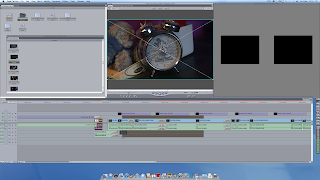
Though, we created many camera effects using Final Cut Pro. Our most interesting effect was the ident transition created for our (Fictional) independent distributor, DAK Pictures. We created this one using Motion. Though, it was hard to create, at first. We soon got the hang of it and created a simple slide of film. However, for those who might criticise how simple our ident is, other groups have taken distributor idents off the web. We've decided to stay true to teacher's rules and not use any footage from the internet.


The pictures below shows our process in creating an ident:
Motion - the programme we used to create our ident.

We started off by typing our distribution company on a black screen.

From there, we started to experiment with transitions.

This was the playback of our ident with the added transitions. We assure you, it's more complicated than it looks!
Editing - Rough Cut (Pathogen) Feedback
This is feedback for our rough cut opening from fellow student, Andreia. She was honest in saying it wasn't very thrilling and that we had to add more sound. Aside from those two factors, it was a decent bit of film.
Editing - Constructing A Timeline

After we finished filming we used Final Cut Pro to create a timeline and this was tricky because we had a time limit of about 2 minutes for the whole opening. Also because we had to make sure that the clips ran smoothly into each other and that they were at a good pace.
Wednesday, 6 March 2013
Filming - Pathogen (Rough Cut)
On our first day of editing, to initiate we simply put all of our significant clips of footage in the correct order so that we could then continue and go back to add things such as Foley sounds, soundtrack, audio/video transitions and filters, and most importantly the conventional order of TITLES. As it is a thriller opening.
Our main priority post filming was to synchronise the clips and you can see from this rough cut of Pathogen that it was far from finished and lacking emphasising conventions such as effects.
Monday, 4 March 2013
Filming - Shoot 2
This filming session took place on Monday, 18th February, at Cara's house. Being half-term, we thought it was an appropiate time to re-film the whole of Cara's scene. The problem with our orginal footage being that it was far too dark. Though, the footage appeared alright on the camera's small screen, Final Cut Pro suggets differnty of the lattter.

Not sure what Anthony's doing with the microphone, testing to see if the sound was clear.

Another picture of Anthony, this time. tweaking slight adjustments to the top light.

Kellie and Deborah are about to film Cara in bed; no pun inteded.

A distorted-looking Cara's ready to film after doing her make-up.
Overall, this filming session was slow as all of us we're rather restless working past the half-term. However, we filmed a great bit of footage and some extra scences with Cara's mother. All we need to do now is concentrate on the editing.
Filming - Shoot 1


We arrived at Cara's house which was our main location, setting out the environment and mise en scene such as an alarm clock prop was our first main priority; it was placed in a specific place and had to be left there through the entire endurance of filming for continuity purposes. (You can also see the camera tripod on the bed if you look closely, the tripod plays a huge part in filming!)

Here Cara was preparing her deadly makeup, it is one of our most important parts of mise en scene as it visually shows the audience what is happening and that she is ill.


We thought that stairs would be a great way to show the main character's instability. We shot things such as medium close ups, tracking shots of her moving feet, low angle shots, and filming from perspective looking through Cara's eyes as she unstabely travels.


This was a quick snapshot took whilst filming and acting was in process.

Anthony with his camera and toplight!
Planning - Production Schedule
Considering the fact that we have a limited amount of filming time, we have to decided to compose a strict timetable to stick to. Below's the dates we intend to film:
- Monday, 11th February - 9:00 - 12:15 - Cara's house - Bedroom and stairs scene
- Thursday, 14th February - 1:15 - 2:55 - Small room next to 323 - Publib Health Official Mr Fissler's office phone call to Kellie Ward, regarding the virus. We intend to film both spectrums of the conversation.
- Monday, 26th February - 9:00 - 12:15 Owen's Field Park - Various death scenes involing the film's extras.
- Monday, 18th February - 9:30 - 4:00 - Cara's house - We intend to use this Monday during the half term to re-film any footage or so.
Planning - Pitch Feedback
As well as receiving feedback from the media department, we also asked our fellow students what they thought of our ideas, whether they believed we were ready to produce it, and got their opinions on the title for our film as they will be the regular civilians we expect to consume/watch it.
Sunday, 3 March 2013
Planning - Pitch
This is our pitch which we presented to members of the media department, we incorporated all of our thoughts and planning aspects into this to give not just ourselves, but others, a clear image of what we wanted our thriller to be.


Make-Up
Make-up is another very important part of mise en scene, especially in our piece because of the 'disease' element in it.
My grandmother is a professional make-up artist, and although she didn't have the free time to do the make-up for us, she lent us her suplies so that we could attempt it ourselves.
Here is the make-up we used:

My grandmother is a professional make-up artist, and although she didn't have the free time to do the make-up for us, she lent us her suplies so that we could attempt it ourselves.
Here is the make-up we used:

Subscribe to:
Posts (Atom)